Case Study
Zchut-AI | AI-Powered Civic Rights Platform
Designed a state-driven AI assistant that helps Israeli citizens discover and manage their social rights, with a focus on accessibility, transparency, and trust.
Role: Product Design & System Architecture (Independent Project)
Deliverables: Mobile app · Web dashboard · AI interaction system
Focus: AI transparency · Accessibility · Institutional trust
Bureaucracy wasn't designed for everyone
Israel's government services are fragmented, jargon-heavy, and increasingly digital-first. For two large population groups - seniors and new immigrants - this isn't inconvenient. It's exclusionary.
RESEARCH INSIGHT
Our initial assumption: users need more information.
What we found: they need interpretation and confidence to act.
The information exists on platforms like Kol Zchut. The barrier is linguistic complexity and the anxiety of acting on something you don't fully understand.
One platform. Two interaction models.
Different tasks require different levels of AI involvement. The system separates deterministic processes from open-ended interpretation and routes each to the appropriate interaction model.
Guided Flow
Structured, step-by-step
Used for: eligibility checks, document submission, deadline tracking
Deterministic, clear inputs, clear outputs
Isaac: "Am I eligible for home-care benefit?" → structured checklist
Conversational AI
Natural language input
Used for: rights inquiry, document interpretation, escalation
Interpretive, ambiguous inputs, confidence-tiered outputs
Elena: scans tax letter → AI summarizes, flags urgency
Both models feed into the same underlying rights database. The interaction layer adapts; the data layer doesn't change.
The AI knows what it doesn't know
In a civic context, an AI that presents uncertain information with false confidence causes real harm - missed deadlines, wrong claims, financial loss. The system uses a three-state confidence model to make uncertainty visible before the user acts.
state
When it triggers
What the user sees
What the system does
Confident
Query is in-scope, high confidence score
Full answer + source tag
Logs interaction
Partial
Low confidence or edge-of-scope
Answer + "Verify with an advisor" warning
Flags for review queue
Escalate
Out-of-scope or critical legal domain
This requires professional review - no AI answer shown
Routes to advisor with full context
CONCEPT PROOF
Partial response detected. User sees inline caution state. Advisor queue entry created with full query context.
Escalation is a designed transition, not a fallback. The user sees the boundary before they hit it.
Design Decisions & Trade-offs
DECISION
Guided flow vs. open conversation
Structured flows reduce cognitive load for deterministic tasks. Conversational AI handles ambiguity. Separating the two prevents the system from feeling unpredictable.
Trade-off
Transparency vs. simplicity
Showing confidence states adds cognitive overhead. But hiding uncertainty in a civic context causes more harm than complexity. We chose to show the seams.
Trade-off
Escalation as a feature, not a fallback
Routing to a human advisor could feel like failure. We reframed it as a designed transition: the user sees the boundary before they hit it.
CONCEPT PROOF
Partial response detected. User sees inline caution state. Advisor queue entry created with full query context.
AI Data Flow & Extraction
To minimize cognitive load, the system acts as a "translator" between human natural language and complex bureaucratic requirements. Instead of forcing users to navigate through tedious forms, an LLM engine processes unstructured input—such as voice recordings or free text—extracts relevant entities (dates, names, statuses), and maps them directly into structured form fields. This architecture preserves the simplicity of a conversation while delivering the precision of a structured legal document.
Unstructured Input
Voice recordings or free text input from the user.
LLM Processing
NLP identifies intent and extracts key data entities.
Structured Output
Data is automatically injected into standard form fields.
Key Screens
Each screen resolves a specific tension between accessibility and trust.
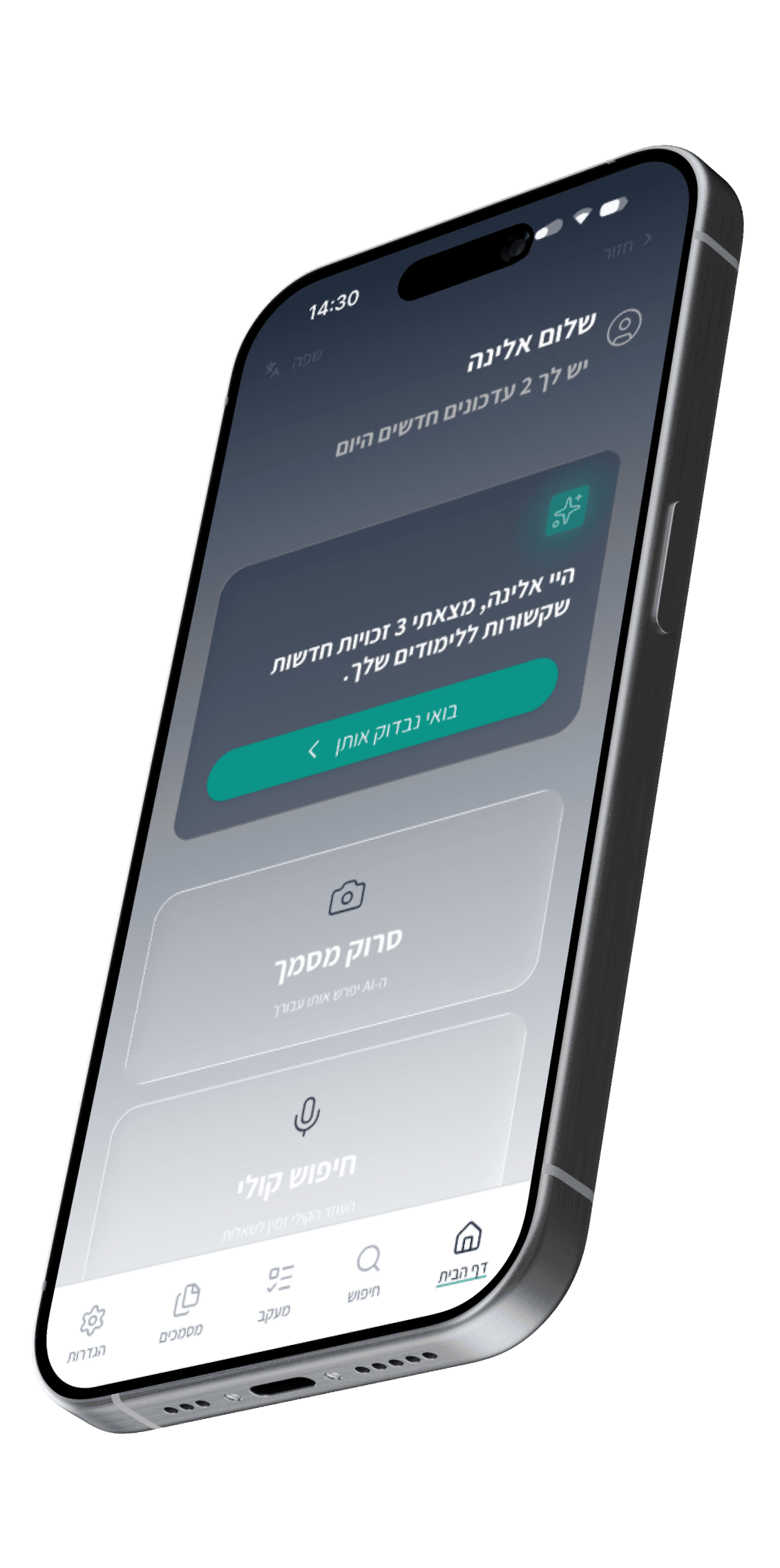
14:30

שפה
שלום יצחק
עודכנו עבורך זכויות וסטטוסים רלוונטיים
צפה בעדכונים
סרוק מסמך
ה-AI יפרש אותו עבורך
חיפוש קולי
העוזר הקולי זמין לשאלות
הזכויות שלך
מאושר
הנחה בחשמל לאזרח ותיק
עודכן לאחרונה 20/01
בטיפול
קצבת זקנה (אזרח ותיק)
עודכן לאחרונה 20/01
מאושר
סיוע בשכר דירה
עודכן לאחרונה 20/01
הגדרות
מסמכים
מעקב
חיפוש
דף הבית


Home Dashboard (Mobile)
Global Search
Proactive Alerts
Quick Access
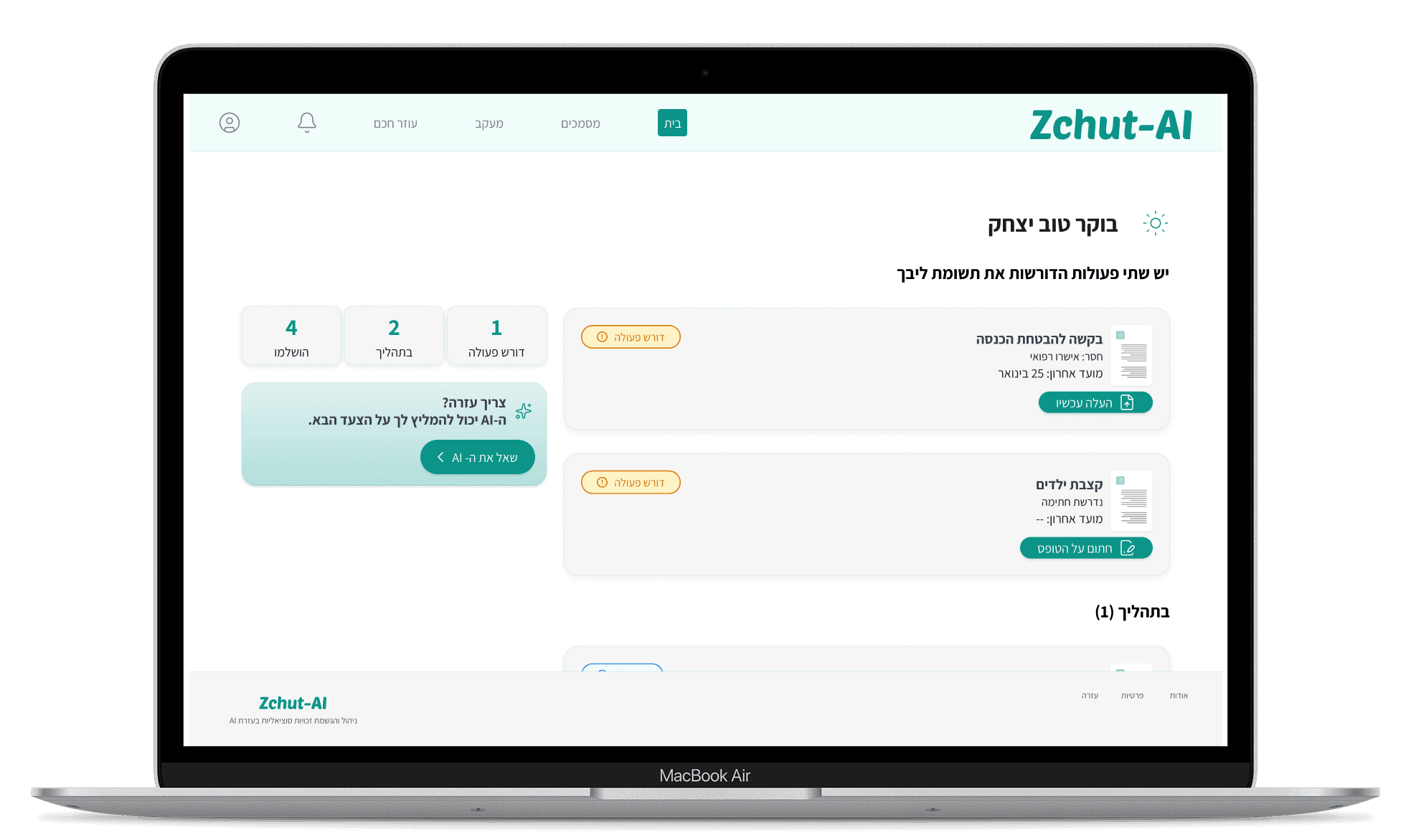
What this proves: A senior user can understand their rights status, pending actions, and new entitlements at a glance without navigating menus.
Personalized rights summary surfaces proactively based on user profile, not search
Status indicators distinguish between 'available now,' 'pending,' and 'requires action' without legal jargon
Voice Assistant (Mobile)
Barrier-Free Input
Natural Language
Zero Literacy Friction
What this proves: Voice input isn't a feature. It's an accessibility requirement for users who find typing in bureaucratic contexts intimidating.
Waveform UI provides real-time feedback that the system is listening and processing
Input is transcribed and confirmed before the AI responds, reducing anxiety about being misheard
14:30
שפה
חזור
עוזר קולי
האם מגיעה לי הנחה בארנונה..
סיים הקלטה
14:30
פלאש
חזור
מזהה מכתב מביטוח לאומי...
החזק יציב
המסמך ייסרק וינותח אוטומתית
צלם
העלה מהגלריה
Document Scanner / AI Chat (Mobile)
Capture in Context
On-Device Action
From Paper to Insight
What this proves: A new immigrant can resolve white-envelope anxiety in under 60 seconds.
OCR scan feeds directly into AI interpretation — no manual re-typing
AI response includes urgency classification: 'routine update' vs. 'deadline detected'
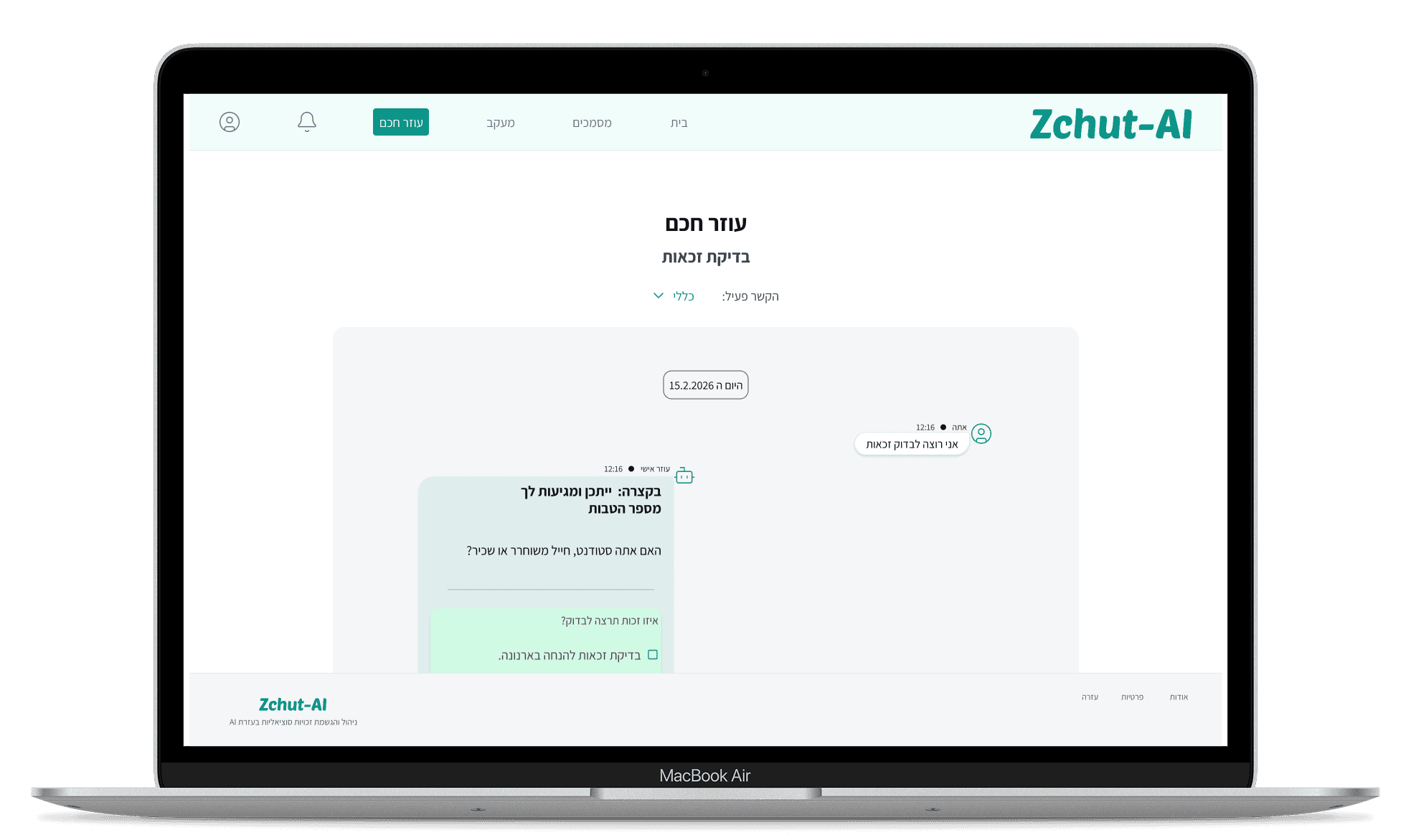
AI Chat with Escalation (Desktop)
Guided Exploration
Conversational Depth
No Legal Jargon
What this proves: When the AI reaches the edge of its competence, the handoff to a human is visible, designed, and context-preserving.
Escalation trigger is shown inline. The user understands why before they're redirected.
Advisor receives full conversation context. The user does not need to re-explain.
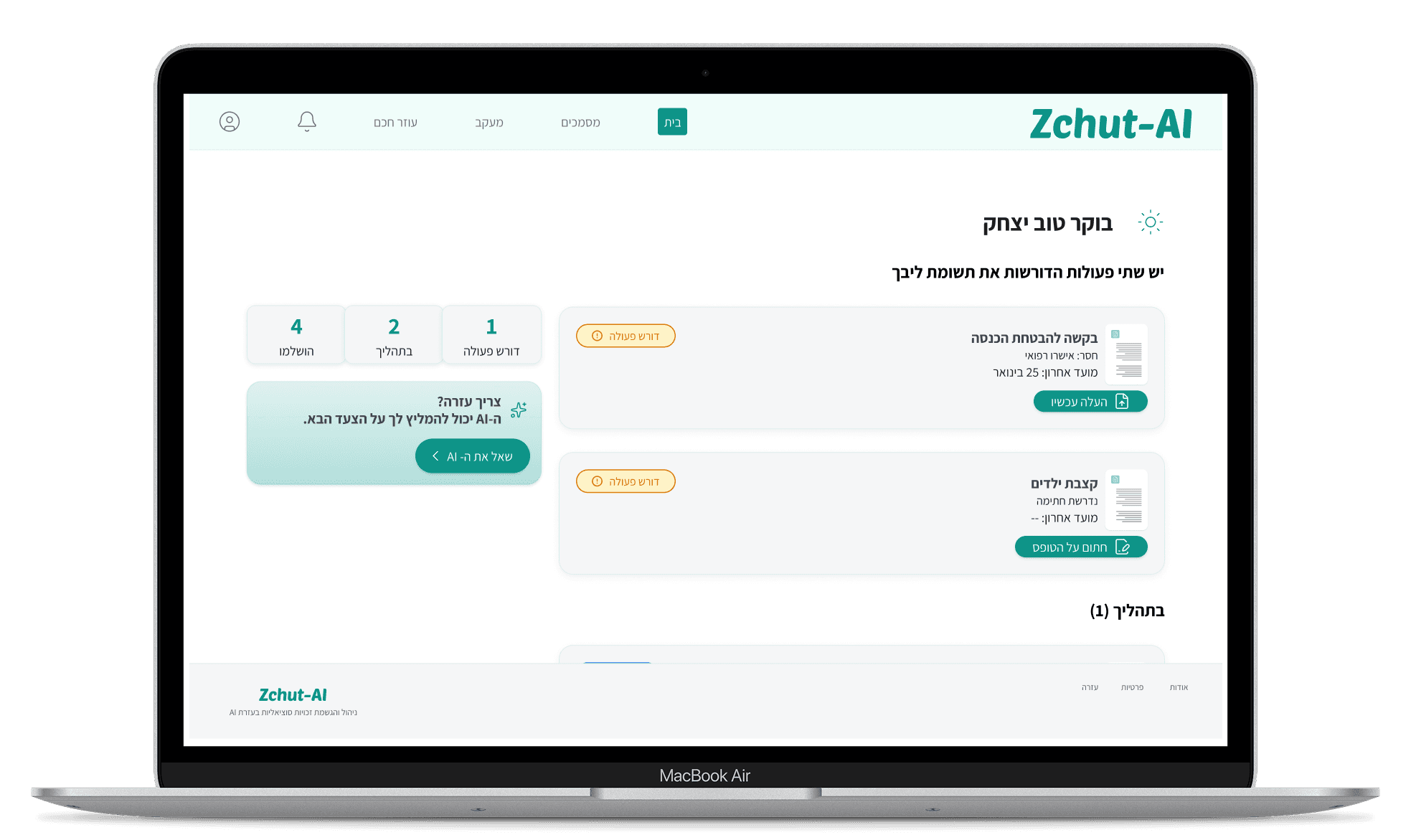
Benefits Dashboard with Deadlines (Desktop)
Full Picture View
Status at a Glance
Actionable Overview
What this proves: The system's value isn't just answering questions. It's proactively surfacing entitlements users don't know to ask about.
Deadline tracking is visible and calendar-integrated, removing the fear of missing a critical date.
Progress indicators show where each benefit claim stands in the submission process
Outcome
Zchut-AI demonstrates that designing for extreme users - those most excluded by existing systems - produces a better product for everyone. The dual interaction model, confidence-tiered AI, and escalation system aren't accessibility features bolted on. They're the core architecture.
The project also proves a broader design thesis: AI in high-stakes civic contexts requires a trust layer, not just a response layer.
What I'd Measure
© 2026 Guy Bar-Sinai. Built with intention.
This site is a design exploration.